
Vision is essential in people’s lives for a variety of tasks from reading to driving. The health of people’s eyes contributes to completing these tasks effortlessly. However, some eye problems may cause vision deterioration immediately and must be treated. Detached retina is among them.
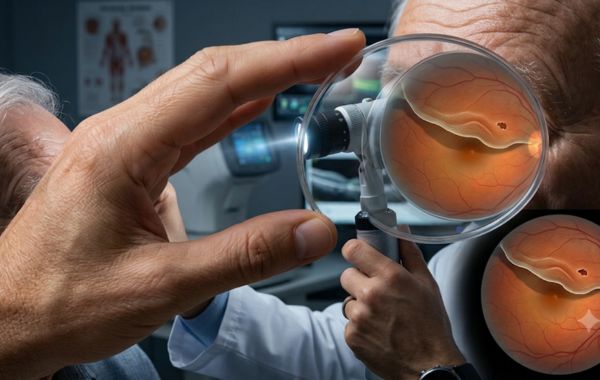
This problem refers to a condition where the retina gets separated from its normal location inside the eye. People have a thin layer of tissue responsible for receiving light and transmitting visual impulses to the brain. Once the retina becomes detached from its normal place, it stops working properly and causes various symptoms including blurry vision, flashes of light, floaters and potentially vision loss.
It is common for people to think about natural ways to deal with their detached retina. Unfortunately, it is not possible. Detached retinas usually do not get back to their original places naturally. However, there are a few medical treatments which can be used to reattach the retina and save the rest of people’s vision.
What Actually Happens When the Retina Becomes Detached?
Retina acts as the photoelectric film of the eye. It takes the information about light and transmits the data to the brain via the optic nerve. To achieve clear vision, the retina has to maintain constant contact with the underlying layer of supporting tissue.
Retinal detachment occurs when the light-sensitive membrane separates from its proper place. The result is a lack of necessary support that retinal layers require to operate normally.
Often, the condition starts with retinal tearing or retinal hole. The fluid gets through the opening and settles beneath the retina, separating it from the back layer of the eye.
The bigger the gap between the tissues gets, the more the area becomes dysfunctional. If the center of the retina, known as macula, becomes detached, the sharpness of vision may suffer.
That is the reason why the condition should not be treated as an ordinary vision impairment.
Can a Detached Retina Fix Itself Without Medical Treatment?
Complete detachment of the retina will not heal by itself without any form of medical intervention. While minor injuries on the surface can heal on their own, the retina cannot reattach on its own once it becomes completely detached.
Sometimes, when there is a tear on the retina, it can be healed before complete detachment occurs. An ophthalmologist may apply laser or freezing treatment on the tear to prevent further detaching of the retina.
If there is complete detachment, then there is a need to undergo medical treatment to reattach it. Simply ignoring the problem and waiting for it to go away will just make it worse.
Some individuals will realize that the flashes and floaters will lessen after some time. It should not be mistaken as the reattachment of the retina.
The only way to confirm if there is a tear or detachment in the retina and how it will be cured is through an examination by a retina specialist.
Warning Signs That Should Never Be Ignored
Retinal detachment may occur suddenly, and the symptoms may be evident within a relatively short amount of time. The knowledge of these symptoms can help individuals see a doctor before additional vision loss occurs.
A Sudden Increase in Floaters
Floaters appear as dark dots, spots, threads, or cobwebs floating in the field of vision. While floaters are quite common, a sudden increase in their number may be indicative of a retinal tear or other retinal problems.
Flashes of Light
Individuals experience quick flashes of light that appear as they move their eyes. Flashes of light may occur when the gel within the eye tugs at the retina.
Persistent or sudden flashes should be evaluated by an eye doctor.
A Dark Shadow or Curtain
Another more alarming sign is a dark shadow developing on one side of your vision and then moving towards the center of your eyes. It will seem like a curtain that covers part of what you are able to see.
It could mean that the retina is starting to detach and should be treated immediately.
Blurry or Decreased Vision
The retinal detachment will cause certain parts of your retina to stop working properly and send blurry information to your brain. Therefore, it may lead to blurriness and decreased eyesight.
In case the macula gets affected, it will become hard to read, recognize faces and see small things clearly.
What Treatment Options Can Bring a Detached Retina Back Into Position?
Depending on the detachment site and size, the number of retinal breaks, and involvement of the macula, the doctor chooses an appropriate treatment approach.
The primary purpose of the treatment is to return the retina to its natural position and seal the retinal tears or breaks causing the detachment.
1. Pneumatic Retinopexy: With the Help of a Gas Bubble
Pneumatic retinopexy is one of the treatments that can be used for some types of retinal detachment. In this method, a gas bubble is inserted by the doctor into the eye.
The gas bubble pushes the detached portion of the retina towards the eye wall and laser or freezing treatment is applied to seal the retinal tear.
After the procedure, a patient may have to keep his/her head in a certain position for several days since the gas bubble needs to remain in place until the retina heals.
With time, the gas bubble dissolves as the eye refills with the fluid produced by itself.
This type of treatment is not suitable for all cases of retinal detachment and the location and number of retinal breaks is an important factor in determining its applicability.
2. Scleral Buckle Surgery: Providing Support to the Outside of the Eye
Scleral buckling surgery is yet another way of treating retinal detachment. In this type of surgery, the surgeon will place a small band around the eye.
This band will push the walls of the eye inward towards the retinal detachment. It will ease the pulling pressure on the retina, thereby helping the retina settle back in the right position.
The surgery can also involve using a laser or freezing to close the retinal tear.
The buckle will normally stay on the eye forever. It is not normally visible on the outside.
3. Vitrectomy: Removal of the Jelly Pulling the Retina
Vitrectomy surgery is used to treat complicated cases of retinal detachment. In the process of surgery, the surgeon will remove the vitreous jelly that might be pulling the retina.
The surgeon will repair the holes in the retina and put either gas or silicone oil into the eye.
In case of gas, it will eventually be absorbed by the body. Silicone oil will have to be removed by another surgery at a later stage.
Patients may be required to keep their head in a particular position during recovery after surgery.
Comparing the Main Retinal Detachment Treatments
Each treatment has a different purpose and is suitable for different situations. The following table provides a simple comparison.
| Treatment | How It Works | When It May Be Used |
|---|---|---|
| Pneumatic Retinopexy | A gas bubble pushes the retina into position, while laser or freezing seals the tear | Selected detachments with suitable retinal breaks |
| Scleral Buckle | A flexible band supports the outside of the eye and helps the retina reattach | Certain retinal detachments, depending on their location and features |
| Vitrectomy | The vitreous gel is removed and a gas or oil bubble supports the retina | Larger, complex, or more difficult detachments |
| Laser Treatment | Laser creates small scars around a retinal tear to seal it | Retinal tears and selected small, localized problems before a larger detachment develops |
| Cryotherapy | Freezing treatment creates a seal around a retinal tear | Selected retinal tears and detachment repairs |
How Do Doctors Confirm a Detached Retina?
In order to provide a recommendation on treatment, the specialist should first find out the extent of the damage to the retina. There are various options for diagnosing a retinal problem.
Dilated Retinal Exam
The specialist uses eye drops to dilate pupils and examine the rear part of the eye in order to determine whether there are any retinal problems such as tears, fluid presence, or detachment.
Optical Coherence Tomography (OCT)
Using OCT, the specialist may take highly detailed images of the retina in order to see whether the macula is in place and whether there are any changes in its structure.
Ultrasound of the Eye
In case when the retina cannot be examined properly, the specialist may perform an ultrasound test that helps to produce images of the interior parts of the eye in order to diagnose retina detachment.
These diagnostic techniques help the specialist to determine the disease and the right way to treat it.
What Should You Expect During Recovery?
Recovery from having undergone retinal detachment surgery varies from one person to another and is based on different factors, such as the procedure performed, retinal damage, and macular involvement.
Following surgery, it is expected for one to have slight pain, redness, swelling, and blurry vision. It can take several weeks for complete recovery.
It is important for patients to strictly adhere to the directions of their retina specialist. These may include taking medication in the form of eye drops and avoiding physical strain.
Importance of Head Positioning
When the gas bubble is injected into the eye, there will be a requirement for the head position that allows the bubble to make pressure on the right spot on the retina.
Head position and time required for this depend on what type of surgery was done and on where the tear is located.
What Activities Not To Do After the Surgery
Patients who have an intraocular gas bubble will be asked not to use air flights and to stay away from any altitudes until the gas is gone and until the specialist says that you are okay.
Sometimes it is necessary not to do scuba diving and some other activities. Instructions will be provided by the specialist.
It is important to contact your eye specialist if you experience any pain, redness, swelling or vision problems after the operation.
Does a Detached Retina Cause Permanent Vision Loss?
If a person does not receive prompt treatment, he/she may become permanently blind. However, the earlier one detects and treats the problem, the higher are the chances to preserve one’s vision.
One of the criteria that plays a significant role is the state of the macula.
The macula allows us to see the central vision such as reading, recognizing faces and noticing small objects. If the retina detaches before the macula becomes detached, the chances to save the central vision are higher.
However, in case if the macula has already become detached, the person may experience difficulties with restoring his/her vision even after the operation.
It should be remembered that Macular Degeneration is another disease. This eye disease affects the macula due to the aging processes, while Retinal Detachment means the separation of the retina from its underlying layer.
Conclusion
Retinal detachment is a grave problem which should not be neglected at any price. It rarely heals without any treatment, and a delay in visiting a doctor may result in loss of sight forever. Knowing what symptoms to look out for, such as flashes of light, floaters, blurriness, and dark shadows, can save one’s sight.
There are modern techniques used in repairing a retina, such as pneumatic retinopexy, scleral buckle surgery, and vitrectomy. Depending on the nature of the disease and the patient’s overall condition, one method is chosen from these options.
Preservation of the health of a retina presupposes examinations and special care. Retina and Vitreous Surgeons of Utah provides specialized services regarding examinations of the retina and vitreous. Visiting a doctor when something unusual is observed with your sight may help a lot in making treatment choices.