
A Common and Often Harmless Finding in Your Eye Exam
If your retinal specialist mentioned the term “cobblestone retina degeneration” during your last eye exam, you might have felt a flash of concern. The retina is a delicate part of your eye, and hearing about a “degeneration” can sound alarming. However, we’re here to reassure you that for the vast majority of people, cobblestone retina degeneration is a common, benign, and typically harmless condition.
At RVSU, our goal is to provide clear, expert information on all aspects of retinal health. Here is a comprehensive overview of what you need to know about this specific peripheral retinal finding.
What Exactly is Cobblestone Retina Degeneration?
Cobblestone retina degeneration, also known medically as paving-stone degeneration or peripheral chorioretinal atrophy, is a finding located in the far outer edge (periphery) of the retina.
The term “cobblestone” is highly descriptive of its appearance. When viewed by a specialist, the condition looks like small, round, or oval-shaped, pale areas clumped together, resembling an old stone street or cobblestone pavement.
These areas are essentially small patches where the retina, the retinal pigment epithelium (RPE), and the underlying blood supply (choriocapillaris) have thinned or atrophied.
Symptoms and Diagnosis
One of the most important facts to know about cobblestone retina degeneration is that it is overwhelmingly asymptomatic.
Most patients with this condition will never:
- Experience a change in their central vision.
- Notice a change in their peripheral vision.
- Report flashes of light or new floaters caused by the degeneration itself.
How is Cobblestone Retina Degeneration Discovered?
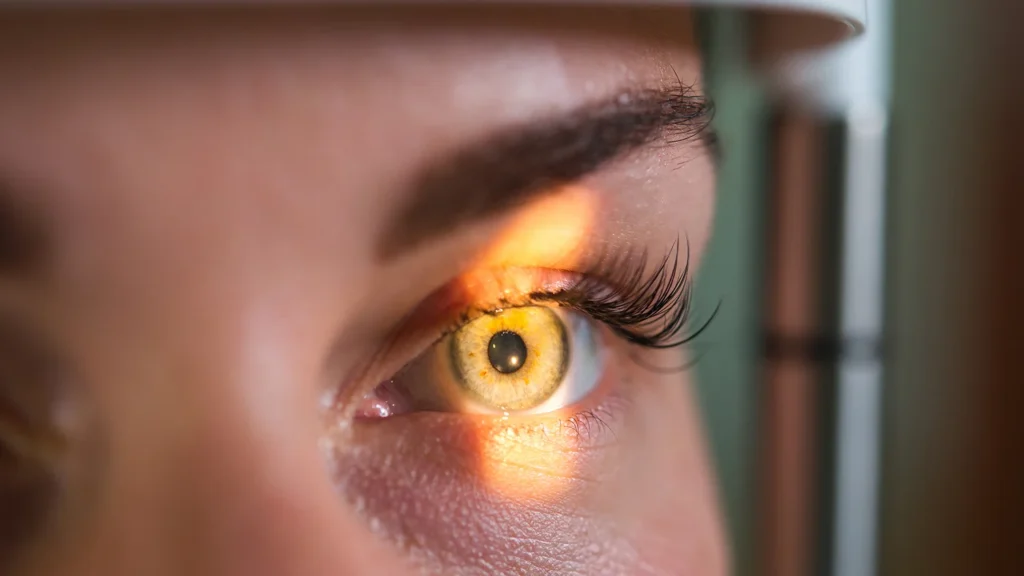
The condition is almost always discovered incidentally during a comprehensive dilated eye examination performed by a retina specialist or ophthalmologist.
- The eye doctor uses specialized instruments to view the entire circumference of the retina, often utilizing techniques like scleral depression to examine the far periphery where these lesions reside.
- The appearance is distinct and easily recognized by trained professionals.
Key Diagnostic Facts:
- It is located in the most peripheral retina, typically near the ora serrata (the scalloped edge where the retina meets the ciliary body).
- It is far less common in the upper quadrant of the eye compared to the lower.
- It is generally non-progressive, meaning the existing lesions do not typically grow or become worse over time.
Is Cobblestone Retina Degeneration a Risk for Retinal Detachment?
This is the most frequent question patients have, and the answer is reassuring: No, cobblestone retina degeneration is generally not considered a significant risk factor for retinal detachment.
This finding is typically classified as a low-risk degeneration. While any break in the retina could theoretically lead to a detachment, the borders of cobblestone degeneration lesions are usually rounded, smooth, and strongly adhered to the underlying tissue. They do not tend to form the tractional tears that lead to retinal detachment.
Cobblestone vs. Lattice Degeneration
It is crucial to understand that cobblestone degeneration is a completely different condition from lattice degeneration.
| Feature | Cobblestone Retina Degeneration | Lattice Degeneration |
| Appearance | Round, pale, “paving-stone” lesions. | Oval, spindle-shaped, basket-weave-like thinning. |
| Location | Closest to the outermost edge of the retina. | Just anterior to the equator (more central). |
| Retinal Detachment Risk | Very Low (typically benign). | Higher (can be associated with tractional tears). |
Your Utah retina specialist will always differentiate between these two conditions during your exam, as their management protocols are very different.
Who is Most Affected by Cobblestone Retina Degeneration?
While anyone can develop this condition, it is more commonly seen in specific populations.
- Age: It is more prevalent in older individuals.
- Myopia (Nearsightedness): People with mild to moderate nearsightedness are more likely to have cobblestone degeneration. The shape of a myopic eye causes a stretching of the peripheral retina, making these findings more common.
The Bottom Line: Monitoring and Management
The good news is that cobblestone retina degeneration generally requires no treatment.
Because the condition carries a very low risk of complications, no surgical intervention (like laser or cryopexy) is typically needed.
What You Need to Do:
- Continue Routine Monitoring: The most important step is to maintain your regular, scheduled comprehensive eye exams. This allows your specialist to ensure the lesions remain stable and that no other, more concerning changes are developing in your retina.
- Know the Warning Signs: While the condition is stable, you should always seek immediate attention if you notice any sudden changes, such as:
- A sudden increase in the number of floaters.
- Flashes of light (photopsia).
- A curtain or shadow moving across your vision.
At RVSU, we specialize in the comprehensive care and expert diagnosis of all retinal conditions. If you’ve been told you have cobblestone retina degeneration, we encourage you to schedule a consultation with one of our experienced specialists to ensure an accurate diagnosis and get peace of mind. Your vision is our priority.
To schedule your comprehensive retinal evaluation, please contact ustoday.