
Your eyes are your windows to the world. Inside your eye, a thin layer of tissue called the retina acts like the film in an old camera. It captures light and sends pictures to your brain so you can see your family, drive a car, and read this text. When a retinal disease damages this tissue, your vision faces serious danger. Diseases like macular degeneration and diabetic retinopathy can cause permanent vision loss if a doctor does not catch them early.
New technology is helping eye doctors find these problems earlier. Artificial intelligence (AI) helps retina specialists review eye scans more quickly and carefully. It does not replace your doctor. It simply helps them make better decisions.
What Is Retinal Disease?
The retina sits at the very back of your eye. It is full of tiny blood vessels and sensitive cells. Because the retina is very delicate, even small problems can affect your vision.
Several common conditions can damage this area of the eye:
- Age-Related Macular Degeneration (AMD): This disease breaks down the center of the retina, which is called the macula. It makes your central vision blurry, making it hard to recognize faces or read books.
- Diabetic Retinopathy: High blood sugar from diabetes damages the tiny blood vessels inside the retina. These vessels can leak fluid or bleed, which blocks your sight.
- Retinal Vein Occlusion (RVO): This happens when one of the retina’s blood vessels becomes blocked, reducing blood flow and affecting vision. It can cause sudden vision loss.
- Retinal Detachment: This is a medical emergency called retinal detachment, where the retina pulls away from its normal position at the back of the eye.
Finding these diseases early gives doctors the best chance to protect your vision. To do this, they look at detailed pictures of the inside of your eye.
How Retina Imaging Works
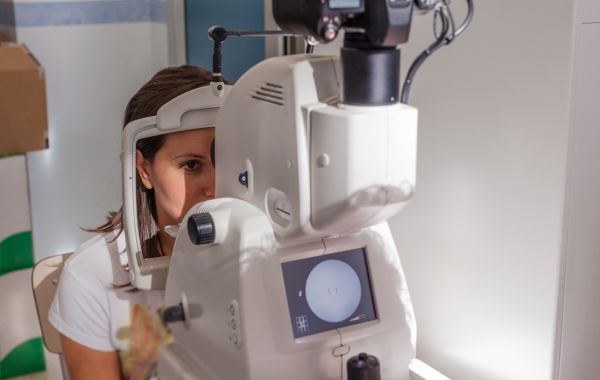
To check your eye health, a retina specialist uses special cameras to take highly detailed photos. One common test is called Optical Coherence Tomography (OCT). An OCT scan is a painless test that takes detailed pictures of the inside of your eye.
These pictures help your eye doctor see the different parts of your retina clearly. One eye exam can create many clear pictures. Your eye doctor checks them for swelling, bleeding, or other signs of disease.
How Artificial Intelligence Works in Eye Care
Artificial intelligence (AI) is a computer tool that helps find signs of eye disease. To help with eye care, engineers feed millions of retinal photos into a computer system. Some photos show healthy eyes, while others show eyes with diseases like diabetic retinopathy or macular degeneration.
The computer studies many eye images. Over time, it learns the difference between healthy and unhealthy retinas. This helps it find small changes that may be easy to miss. When you have an eye scan, AI can review the picture in just a few seconds. It points out areas your eye doctor should check more closely. Studies show that AI can find signs of diabetic retinopathy with very high accuracy.
Benefits of AI in Retina Care
Using computers to analyze eye scans offers several major advantages for patients and doctors.
1. Faster Results
Eye diseases can progress quickly. If you have wet macular degeneration, fluid can build up under your retina and cause damage within weeks. AI can review an eye scan in seconds. This helps your doctor decide on the next steps more quickly.
2. Earlier Detection
Early signs of retinal disease can be very small and easy to miss. AI helps doctors notice these changes sooner. AI checks every part of the image the same way every time. This helps doctors find problems before they become more serious.
3. Better Access to Care
Not every town has a trained retina specialist. People living in rural areas often have to drive hours to get a specialized eye exam. With AI, a local eye doctor or optometrist can take a picture of your retina and check it quickly. If the scan shows a problem, you can be referred to a retina specialist sooner.
| Feature | Standard Eye Photo Review | AI-Assisted Eye Photo Review |
|---|---|---|
| Analysis Speed | Several minutes per patient | A few seconds |
| Fatigue Factor | Doctors can get tired after long shifts | Computers perform the same all day |
| Early Detection | Relies on visible changes to the human eye | Spots pixel-level changes instantly |
| Availability | Requires an in-person specialist | Can be used in remote clinics |
AI in Eye Clinics
Artificial intelligence is not a futuristic concept. It is already active in medical offices across the country.
- Autonomous Screening: The Food and Drug Administration (FDA) has approved autonomous AI systems to screen patients for diabetic retinopathy. A camera takes a picture of the eye. AI checks the image and lets the doctor know if the patient should see a retina specialist.
- Fluid Volume Tracking: If you receive eye injections for macular degeneration, AI can measure the fluid under your retina. This helps your doctor see if your treatment is working.
- Predictive Analysis: AI can compare your eye scans over time. It helps doctors see if your eye disease may get worse, so they can plan treatment earlier.
Why Your Retina Specialist Matters
Some people worry that computers will replace human doctors. In eye care, this is not true. AI is a tool, not a replacement.
A computer program can find a spot on an image, but it cannot talk to a patient. It does not know your medical history, your lifestyle, or your personal goals. It cannot perform delicate eye surgeries or administer treatments.
AI gives your doctor helpful information, but your retina specialist makes the final decisions about your care and treatment.
Conclusion
Living with a retinal condition can feel stressful, but new technology makes managing your eye health easier every day. By combining the deep skills of experienced retina specialists with the incredible speed of artificial intelligence, modern eye clinics can protect your sight more effectively than ever before. If you have diabetes, a family history of macular degeneration, or notice sudden changes in your sight like blurriness, wavy lines, or dark spots, do not wait for your vision to get worse.
Regular eye exams are the single best way to catch serious issues before they cause permanent, irreversible damage. We encourage you to take control of your eye care and reach out to our team of experts today. Please contact us to schedule a comprehensive retinal exam, meet our specialists, and give your eyes the high-tech protection and compassionate care they deserve.