
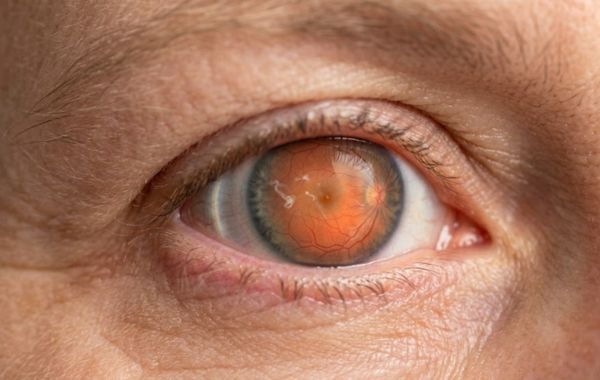
If you have started seeing spots floating across your vision or brief flashes of light off to the side, it can be unsettling. Most of the time, these are related to changes in a part of your eye called the vitreous. It is not something most people think about until something feels different.
The vitreous makes up most of the inside of your eye. As you get older, it changes. Those changes are behind the majority of floaters and flashes that adults start noticing after 50. Understanding what is happening can help you figure out what is normal and what needs a doctor’s attention.
What Is Vitreous?
The vitreous, also called vitreous humor or vitreous gel, is a clear, jelly-like substance that fills the inside of your eye. It sits in the large space between your lens and your retina. Think of it as the filling inside a grape. It helps your eye keep its round shape and lets light pass through cleanly to the retina at the back.
When you are young, the vitreous is firm and clear. It sits tight against the retina and holds its structure well. You would never notice it because it is just doing its job quietly. But as you get older, that changes. And those changes are behind most of the floaters and flashes that adults over 50 start to see.
What Happens to the Vitreous as You Age
Starting sometime in your 40s or 50s, the vitreous begins to break down. The collagen fibers that kept it firm start to clump together. The gel in the center starts to liquefy. Small pockets of watery fluid form inside what used to be a solid structure. This process is called vitreous syneresis, and it is completely normal. Pretty much everyone goes through it.
As those clumped fibers float around in the now-watery gel, they cast tiny shadows on the retina. Those shadows are what you see as floaters. They can look like spots, threads, little squiggles, or cobwebs. They drift when you move your eye and then slowly settle. Floaters are one of the most common age-related eye changes out there, and almost all of them come back to this same process.
What typically changes inside the vitreous over time:
- The central gel gradually turns more liquid (vitreous syneresis)
- Collagen fibers clump and float freely inside the eye
- Eye floaters begin to show up, usually as spots, strings, or cobwebs
- The total volume of the vitreous shrinks slightly
- The attachment between the vitreous and the retina starts to loosen
These changes happen slowly. For a lot of people it is mild and barely noticeable. But for others, the process eventually leads to something called posterior vitreous detachment.
Posterior Vitreous Detachment: What It Is and Why It Happens
- The central gel gradually turns more liquid (vitreous syneresis)
- Collagen fibers clump and float freely inside the eye
- Eye floaters begin to show up, usually as spots, strings, or cobwebs
- The total volume of the vitreous shrinks slightly
- The attachment between the vitreous and the retina starts to loosen
These changes happen slowly. For a lot of people it is mild and barely noticeable. But for others, the process eventually leads to something called posterior vitreous detachment.
Common Symptoms Tied to Vitreous Changes
Most people first realize something is changing because of new floaters or those flashes of light. It can feel alarming if you have never dealt with it before, especially when it comes on fast.
Symptoms that often come with vitreous aging and PVD:
- A sudden increase in floaters that were not there before
- Short flashes of light, mostly noticed off to the side
- A ring or arc of floaters near the center of vision
- Occasional blurry spells that come and go
- A sense of movement at the edges of your visual field
The good news is that for most people, things settle down over time. The floaters do not disappear, but your brain eventually learns to tune them out. The flashes usually stop once the vitreous has fully pulled away from the retina.
Common Symptoms Tied to Vitreous Changes
Most people first realize something is changing because of new floaters or those flashes of light. It can feel alarming if you have never dealt with it before, especially when it comes on fast.
Symptoms that often come with vitreous aging and PVD:
- A sudden increase in floaters that were not there before
- Short flashes of light, mostly noticed off to the side
- A ring or arc of floaters near the center of vision
- Occasional blurry spells that come and go
- A sense of movement at the edges of your visual field
The good news is that for most people, things settle down over time. The floaters do not disappear, but your brain eventually learns to tune them out. The flashes usually stop once the vitreous has fully pulled away from the retina.
When Vitreous Changes Lead to Something More Serious
PVD itself is usually not a problem. The vitreous pulls away, you deal with some floaters and maybe a few flashes, and then it passes. But in some cases, when the vitreous detaches, it pulls hard on a spot where the bond with the retina is especially strong. That force can tear the retina.
A retinal tear does not repair itself. If fluid seeps through the tear and slides underneath the retina, it can lift the retina away from the back of the eye. That is a retinal detachment, and it is a medical emergency. Vision lost from an untreated retinal detachment can be permanent. This is why new or worsening floaters and flashes always deserve a proper check, not just a wait-and-see approach.
Warning Signs That Should Not Wait
Some symptoms are just PVD running its course. Others mean something more serious may be happening. The list below is worth knowing by heart.
See a retina specialist the same day if you notice:
- A sudden shower of new floaters all appearing at once
- A dark curtain or shadow spreading across part of your vision
- Loss of side vision that was not there before
- A gray or dark area descending over your sight
- Flashes of light that are frequent, persistent, or getting worse
These can be signs of a retinal tear or detachment forming. With these conditions, time really does matter. The earlier it is caught, the better the outcome tends to be.
Who Is More Likely to Experience These Changes Earlier
PVD and vitreous aging happen to almost everyone at some point. But some people are more likely to go through it earlier or have complications from it.
Factors that can speed things up or raise the risk of complications:
- Being over 50, with risk going up through the 60s and 70s
- High levels of nearsightedness (myopia)
- A history of eye injury or trauma
- Previous cataract surgery
- Family history of retinal detachment
- Connective tissue conditions like Marfan syndrome
- Diabetes, which affects the overall health of the eye
If several of these apply to you, it is worth asking your eye doctor how often you should be monitored.
How Doctors Look at the Vitreous and Retina
The vitreous cannot be seen during a basic vision check. To get a proper look, a doctor needs to dilate your pupils. Dilation opens the pupil wide and allows a full view of the retina and vitreous using a special lens and light. It takes only a few minutes and is not uncomfortable, though your vision may be a little blurry for a couple of hours after.
Some cases call for more advanced tools. Optical coherence tomography, or OCT, creates a detailed cross-section of the retina and can show whether the vitreous is pulling on certain areas or if there are any signs of tearing or swelling. Ultrasound is another option when the view inside the eye is not clear. A retina specialist uses these tools to get a complete picture, not just a quick look. If you have floaters and flashes that are new or changing, this kind of exam is exactly what gives you a real answer.
Things You Can Do to Keep Your Eyes Healthy After 50
You cannot stop the vitreous from aging. Nobody can. But you can stay on top of your eye health so that if something goes wrong, it gets caught fast.
Practical steps worth sticking to:
- Get dilated eye exams regularly once you are past 50
- Tell your eye doctor about any changes in your vision, even small ones
Manage conditions like diabetes and high blood pressure, both of which affect the retina
- Know the warning signs of retinal tears and detachments and do not wait if they show up
- If you are highly nearsighted or have had eye surgery before, ask about a monitoring plan
What the Floaters and Flashes Are Actually Telling You
For most people, vitreous changes are just a quiet part of getting older. A few floaters here, maybe a flash or two during PVD, and then the eye settles. Your brain adjusts. It becomes background noise. That is the normal path for the majority of people who go through it.
But not everyone follows that path. Sometimes those symptoms are the only warning a person gets before something more serious happens. Retinal tears and detachments do not always come with a lot of obvious signs. A sudden change in what you are seeing, especially one that feels different from what you have noticed before, is your eye trying to tell you something. Trusting that and getting it checked is not an overreaction. It is just good sense.
Don’t Wait to Protect Your Vision If you are noticing new flashes of light, a sudden shower of floaters, or a shadow in your vision, your eyes need an expert evaluation. At Utah Retina, our specialists use advanced diagnostic tools to ensure your retina stays healthy as your eyes change.